






KEY TAKEAWAYS
- The CLARITY Act — the most consequential piece of US crypto legislation since the GENIUS Act — has stalled in the Senate not on technical grounds, but on a single ethics question: should a president who earned $1.4 billion from crypto ventures in 2025 be allowed to regulate the very industry he profits from?
- The arithmetic is brutal: Republicans hold 52 seats, two are expected to vote no on substantive grounds, and Democrats need 8 crossovers to clear the 60-vote filibuster threshold — crossovers Democrats are refusing to deliver without a credible conflict-ofinterest provision.
- The practical deadline is early August recess. If no floor vote is secured before then, the bill almost certainly doesn’t pass in 2026. For crypto markets, delayed regulatory clarity is not neutral — it sustains the institutional hesitation that has weighed on prices throughout H1 2026.
What the CLARITY Act actually does
To understand why its delay matters, it helps to be precise about what the CLARITY Act would change. At its core, the bill ends what critics have long called ‘regulation by enforcement’ — the era in which the SEC and CFTC both claimed jurisdiction over digital assets depending on how the wind was blowing, leaving exchanges, issuers, and investors in a permanent legal grey zone.
The bill draws a clean line: the CFTC gets exclusive jurisdiction over ‘digital commodities’ (i.e., sufficiently decentralised assets like Bitcoin), while the SEC retains authority over ‘investment contract assets’ (tokens that look like securities). It also establishes registration requirements for intermediaries, self-custody protections, and — critically for institutional adoption — a framework for determining when a token has become decentralised enough to graduate from SEC to CFTC oversight.
After the GENIUS Act established the framework for payment stablecoins in July 2025, CLARITY is the second and broader leg of the US digital asset regulatory architecture. The House passed it in July 2025 with bipartisan support. The Senate Banking Committee advanced it 15-9 in May 2026. It should, by any reasonable legislative logic, be on its way to becoming law.
The ethics wall
It isn’t, because of one number: $1.4 billion. That is what President Trump declared in cryptorelated income for 2025 in his annual financial disclosure — $635 million from the TRUMP memecoin licensing, $800 million from World Liberty Financial (WLFI) token sales and equity, $50 million in Bitcoin, $25 million in Ethereum, plus contributions from Melania Trump’s NFT business. Combined, Trump and his family’s crypto exposure sits at approximately $2.3 billion, per Reuters.
For Senate Democrats, this is not an abstraction. It is a direct and documented conflict of interest: the president is simultaneously the primary beneficiary of the crypto industry’s growth and the executive who signs the bill that regulates it. Their demand is simple — any CLARITY Act that doesn’t include an enforceable provision preventing sitting presidents, vice presidents, and senior officials from holding or profiting from crypto businesses isn’t worth their eight votes.
The White House’s counter-offer — limit enforcement to the Attorney General, treat impeachment as the alternative remedy — was rejected by Democratic negotiators as circular, given that the AG serves at the president’s pleasure. A Senate Banking Committee amendment that would have blocked senior officials from holding crypto business interests was defeated 11-13. The result is a negotiation stuck between two irreconcilable positions: Democrats who need a real provision, and a White House that would be signing its own financial restrictions.
The calendar and the math
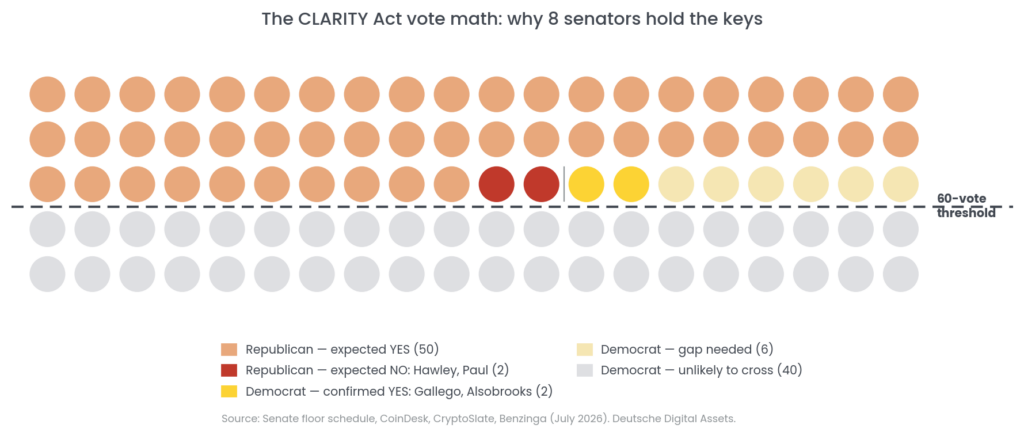
Figure 1 — The CLARITY Act vote math: 52 confirmed votes vs. the 60-vote threshold needed for cloture. Source: Senate floor schedule, CoinDesk, CryptoSlate, Benzinga (July 2026), DDA
The Senate returned from recess on July 13, leaving roughly three weeks of usable floor time before the August recess. Each cloture sequence — one on the motion to proceed, one on the bill itself — can consume the better part of a week. The target date for a new draft combining the Senate Banking and Agriculture Committee versions was expected around July 14-15, but the ethics language remains incomplete.
The arithmetic makes passage this year increasingly unlikely. Republicans hold 52 seats following the death of Senator Lindsey Graham on July 13. Senators Josh Hawley and Rand Paul are expected to vote no on substantive grounds, effectively reducing the Republican base to 50. Currently only two Democrats — Ruben Gallego (AZ) and Angela Alsobrooks (MD) — have shown consistent support, leaving a gap of 8 crossovers to reach the 60-vote threshold. Polymarket currently (as of July 15, 2026) prices the probability of CLARITY being signed into law in 2026 at approximately 37%, down from a peak of 74% in May.
What a delayed CLARITY Act means for markets
Regulatory uncertainty is not a neutral condition for crypto markets. One of the most consistent findings across institutional adoption studies is that legal classification ambiguity — the inability of a fund to know with certainty whether an asset is a commodity or a security — is a primary barrier to allocation. The CLARITY Act’s core value proposition for institutional investors is precisely this: it converts a probabilistic legal grey zone into a defined framework.
The H1 2026 sell-off has multiple causes — macro headwinds, ETF outflows, rising real rates — but sustained institutional hesitation is among them. Spot Bitcoin ETFs, which drove much of the 2024-2025 bull run via structural demand, recorded their worst monthly outflows on record in June 2026 (~$4.5 billion), in part because the regulatory thesis that underpinned many allocations remains incomplete. A CLARITY Act signed into law would not immediately reverse flows, but it would remove a key argument for staying out.
For European investors and for DDA specifically, the dynamic is different but related. MiCA provides a functioning regulatory framework for crypto assets in the EU — in some respects, European institutional investors don’t need CLARITY to allocate. But the US market sets global price discovery, and a US regulatory framework that legitimises the asset class structurally accelerates institutional adoption globally, including in Europe, which ultimately supports ETP flows and AUM
Conclusion
The CLARITY Act is the most technically prepared piece of crypto legislation the US has ever produced. It has bipartisan roots, committee clearance, and broad industry support. What it doesn’t have is a path to 60 votes — and the reason it doesn’t is sitting in the Oval Office.
The most viable off-ramp remains a phased-enforcement compromise: ethics rules written into the statute now but delayed in their application, giving Democrats a provision they can point to while giving the White House a delay that limits immediate personal exposure. Whether that compromise can be assembled before August recess is the central legislative question of the next three weeks. If it can’t, the industry’s best legislative chance in a decade gets pushed to 2027 — and markets will price that delay accordingly.
REFERENCES
[1] CoinDesk — “Trump’s crypto riches loom over Clarity Act talks to ban conflicts for U.S. officials” (July 13, 2026)
[2] Yahoo Finance / Coinspeaker — “CLARITY Act Ethics Talks Stall Over $2.3B in Trump Crypto Holdings”
[3] Fortune — “Democrats are railing against Trump’s $1.4 billion in crypto income. Will his financial disclosure derail
a key crypto bill in Congress?” (July 6, 2026)
[4] CoinGape / Yahoo Finance — “Clarity Act Passing Odds Fall to 39% as President Trump Discloses $1.4B Crypto
Income” (July 1, 2026)
[5] CNBC — “Trump calls for Congress to pass Clarity Act crypto bill to honor Lindsey Graham” (July 13, 2026)
[6] CryptoSlate — “Trump puts Senate on a 24-day clock to find 60 votes for America’s crypto CLARITY Act
rulebook” (July 14, 2026)
[7] Yahoo Finance / CoinSpeaker — “CLARITY Act Stalls in Senate as Three Disputes Block Crypto Regulation 2026”
[8] Skadden — “CLARITY Act: Potential US Tax Implications for Digital Asset Market Participants” (June 2026)
[9] K&L Gates — “Crypto in 2026: The Democratization of Digital Assets”
[10] Bloomberg — XBTUSD price history (January–July 2026)
Important Notices:
The material and information contained in this article is for informational purposes only. Deutsche Digital Assets GmbH, its affiliates, and subsidiaries
are not soliciting any action based upon such material. This article is neither investment advice nor a recommendation or solicitation to buy any
securities. Performance is unpredictable. Past performance is hence not an indication of any future performance. You agree to do your own research
and due diligence before making any investment decision with respect to securities or investment opportunities discussed herein. Our articles and
reports include forward-looking statements, estimates, projections, and opinions. These may prove to be substantially inaccurate and are inherently
subject to significant risks and uncertainties beyond Deutsche Digital Assets’ control. We believe all information contained herein is accurate, reliable
and has been obtained from public sources. However, such information is presented “as is” without warranty of any kind.
This article represents solely a non-binding preliminary information which serves exclusively advertising purposes. It is not a prospectus in the sense
of the Regulation (EU) 2017/1129 (Prospectus Regulation) and the German Securities Prospectus Act (Wertpapierprospektgesetz – WpPG).
Risk Considerations:
The price of an investment in a DDA ETP may go up or down and the investor may not get back the amount invested. The price performance of
cryptocurrencies is highly volatile and unpredictable. Past performance is hence no guarantee of future performance. You agree to do your own
research and due diligence before making any investment decision with respect to securities or investment opportunities discussed herein. The
approval of the prospectus should not be construed as an endorsement of the securities offered or admitted to trading on a Regulated Market. These
are not extensive risk considerations. Prospective investors should read the prospectus before making any investment decision in order to fully
understand the potential risks and rewards of deciding to invest in the securities. The prospectus of each ETP product is available at DDA Crypto ETPs –
Deutsche Digital Assets.
Securities issued by DDA Europe GmbH, DDA ETP GmbH, DDA ETP AG or any other issuer have not been registered under the U.S. Securities Act of 1933,
as amended, (the “Securities Act”). The notes are being offered outside the United States of America (the “United States” or “U.S.”) in accordance with
Regulation S under the Securities Act (“Regulation S”), and may not be offered, sold or delivered within the United States except pursuant to an
exemption from, or in a transaction not subject to, the registration requirements of the Securities Act. The information provided on this website is not
directed to any United States person or legal entity or any state thereof, or any of its territories or possessions. U.S. PERSONS (AS DEFINED IN REGULATION
S) AND LEGAL ENTITIES RESIDENT IN THE UNITED STATES MAY NOT ENTER THIS WEBSITE. Information from this website may not be distributed or
redistributed into the United States or into any jurisdiction where it is not permitted.
@Deutsche Digital Assets │2026│ DDA Crypto Espresso : CLARITY Act: Why the Senate Clock Is Running Out