





KEY TAKEAWAYS
- Google’s March 2026 research reduced the estimated qubit count needed to break Bitcoin’s elliptic curve cryptography by a factor of 20 — compressing a decades-away threat into a potentially decade-away one. The threat is not imminent, but it is no longer theoretical.
- Bitcoin developers have responded with BIP-360 (February 2026), the network’s first quantum-resistant address proposal, and BIP-361, a far more contentious proposal to force-migrate — and potentially freeze — the ~6.9 million BTC sitting in vulnerable legacy addresses, including an estimated 1.7 million coins widely attributed to Satoshi Nakamoto.
- If quantum computing threatens Bitcoin, it threatens everything: TLS, SWIFT, RSA-protected banking infrastructure, and every public-key system underpinning modern finance. The difference is governance speed — and here, Bitcoin’s decentralised consensus model faces its most serious test yet.
What changed in 2026
For most of Bitcoin’s history, the quantum threat was comfortably distant. The working assumption was that breaking Bitcoin’s elliptic curve digital signature algorithm (ECDSA) would require a fault-tolerant quantum computer running around 9 million physical qubits — a machine that existing hardware could not plausibly approach for decades.
Two developments in early 2026 changed the calculus. In March, Google’s Quantum AI team — co-authored with Ethereum researcher Justin Drake and Stanford cryptographer Dan Boneh — published a paper showing the same attack could theoretically be accomplished with fewer than 500,000 physical qubits. That is a 20-fold reduction in the resources required. Separately, a Caltech team argued that a useful fault-tolerant quantum machine could arrive by the early 2030s — not the mid-2040s as previously assumed.
In April, researcher Giancarlo Lelli claimed a 1 BTC bounty from Project Eleven after breaking a 15-bit elliptic curve key using publicly accessible quantum hardware. Bitcoin uses 256-bit keys — the gap remains enormous — but the 512-fold improvement over September 2025 results illustrated how quickly the frontier is moving. Enough so that BlackRock flagged quantum computing threats to Bitcoin in its ETF regulatory filings this year.
The threat has not arrived. No quantum computer capable of attacking Bitcoin’s cryptography exists today. But 2026 moved the conversation from ‘if’ to ‘when’, and narrowed the comfortable margin for preparation.
What Bitcoin can do — and what it can’t
Bitcoin developers have not been idle. On February 11, 2026, BIP-360 was published and merged into Bitcoin’s official improvement proposal repository — the network’s first quantum-resistant address type. It introduces Pay-to-Merkle-Root (P2MR), a new output type that mirrors Taproot’s functionality while eliminating the key-path spend mechanism that creates quantum vulnerability. A working implementation ran on a dedicated testnet (Bitcoin Quantum v0.3.0) in March 2026, with over 50 miners and 100,000 blocks mined.
Two months later, BIP-361 raised the stakes considerably. Formally titled ‘Post Quantum Migration and Legacy Signature Sunset’, it proposes a migration mechanism — and a potential freeze — for the approximately 6.5 to 6.9 million BTC sitting in quantum-vulnerable legacy addresses. That figure includes an estimated 1.7 million coins widely believed to belong to Satoshi Nakamoto, which have never moved.
BIP-361 is where the technical and the philosophical collide. Bitcoin’s security model has always rested on the premise that coins cannot be moved without the private key. Proposing to freeze dormant addresses — even in the name of protecting the network — inverts that premise. Adam Back (Blockstream) and Samson Mow (Jan3) have publicly dismissed the quantum threat timeline as premature. Charles Edwards of Capriole has argued the opposite, calling for BIP-360 implementation by 2026 with non-compliance penalties by 2028.
The optimistic roadmap looks like this: BIP-360 soft fork activation in 2027–2029 (assuming community consensus, which is the binding variable), voluntary migration from 2027, legacy sunset under BIP-361 by 2029–2032. A 5–7 year process from today to full quantum resistance — if everything goes smoothly.
The inconvenient comparison
Here is the question that tends to get lost in Bitcoin-specific coverage: if quantum computing can break Bitcoin’s elliptic curve cryptography, what else can it break?
The answer is: almost everything. The RSA encryption protecting banking communications, TLS securing internet traffic, the public key infrastructure underpinning digital signatures on financial contracts, SWIFT’s interbank messaging — all of it relies on the same class of mathematical problems that a sufficiently powerful quantum computer running Shor’s algorithm would solve in minutes. The G7 Cyber Expert Group, co-chaired by the US Treasury and the Bank of England, published a landmark post-quantum cryptography roadmap for the financial sector in January 2026, explicitly because payment systems and central bank infrastructures face the same exposure.
Citi Research framed it clearly in their 2026 report on the quantum threat: the risk is comparable to ‘a vehicle that continues to run despite compromised tires — functionally adequate for now, yet vulnerable to abrupt failure once stress thresholds are exceeded.’ SWIFT is evaluating post-quantum cryptography for interbank communications. JPMorgan and Goldman Sachs have partnered with IBM and Quantinuum to develop quantum-safe migration programmes. The EU has set a 2030 target for critical infrastructure quantum-resistance.
The difference — and this is the honest answer to the ‘Bitcoin is uniquely vulnerable’ narrative — is governance speed. JPMorgan does not need to achieve consensus among millions of pseudonymous global participants before upgrading its cryptographic infrastructure. It needs a board resolution, a budget, and a vendor. Large financial institutions can and will migrate to post-quantum standards faster, more quietly, and more predictably than a decentralised public blockchain. That is not an argument against Bitcoin. It is an argument for taking its governance process seriously.
The open question: what the BCH/BTC pair tells us
Bitcoin Cash (BCH) offers a revealing data point here. Following its May 2026 CashVM upgrade, BCH became the first major Bitcoin-lineage network to enable quantum-resistant vaults at the protocol level — a genuine head start over Bitcoin. If quantum risk were a meaningful driver of crypto market prices today, you would expect this head start to be reflected in the BCH/BTC pair: BCH appreciating relative to BTC as the quantum narrative intensified through H1 2026. It hasn’t been.
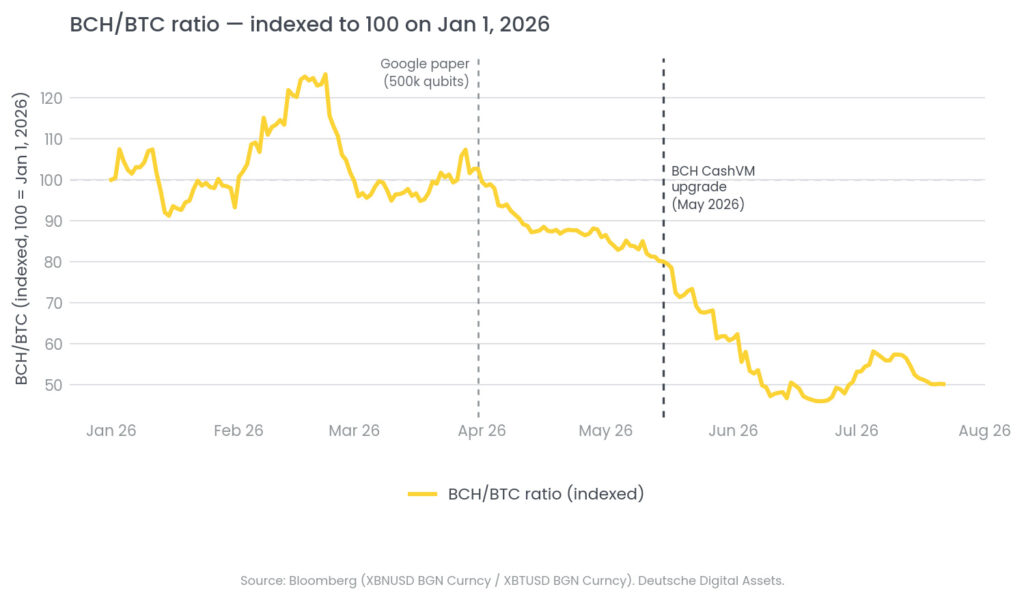
Figure 1 — BCH/BTC price ratio, indexed to 100 on January 1, 2026. Despite BCH’s CashVM upgrade (May 2026) enabling quantum-resistant vaults, the ratio has continued to decline, suggesting markets are not pricing a quantum premium on BCH’s head start. Source: Bloomberg (XBNUSD BGN Curncy / XBTUSD BGN Curncy), Deutsche Digital Assets.
The BCH/BTC ratio has fallen by approximately 50% since January 2026, and has continued to decline after the CashVM upgrade itself. The market is not pricing a quantum premium on BCH — which is evidence that it is treating quantum computing as a deferred, structural concern rather than an imminent pricing catalyst. Which is, we think, broadly correct.
Conclusion
The quantum threat to Bitcoin is real. 2026 has made that clear. What it has not made clear is that Bitcoin is uniquely or immediately at risk — and that distinction matters for how institutional investors should think about it.
The same hardware that could one day break Bitcoin’s signatures will first have to contend with the RSA keys embedded in every bank, every payment rail, and every government communication system on the planet. The financial system will face Q-Day before Bitcoin’s holders do — and the financial system, with its centralised governance and deep pockets, will likely adapt faster. Traditional financial institutions face quantum risk structurally earlier than active Bitcoin wallets, precisely because they depend on long-lived RSA/ECC keys for authentication and interbank communications.
For Bitcoin itself, the path forward exists: BIP-360 is on testnet, NIST standards are published, and the developer community is engaged. The binding constraint is not technology — it is the ability of a decentralised, pseudonymous, globally distributed network to reach consensus on a forced migration before the hardware arrives. That is a governance challenge unlike anything Bitcoin has faced before. The BCH/BTC chart above suggests markets are not yet pricing this as urgent. We think they are broadly right — but the clock is running, and the margin for comfortable procrastination is narrower than it was a year ago.
REFERENCES
[1] Google Quantum AI / Drake & Boneh — “Quantum resource estimates for breaking Bitcoin’s ECDSA” (March 2026)
[2] KuCoin — “Quantum Computing Threat to Bitcoin: 2026 Research Cuts Resource Gap by 20x” (July 2026)
[3] crypto.news — “Bitcoin is going quantum-proof: Inside BIP-360 and the migration” (June 2026)
[4] BTQ Technologies / CryptoTimes — “Bitcoin Quantum testnet v0.3.0 implements BIP-360” (March 2026)
[5] phemex — “BIP-360 Explained: Bitcoin’s first quantum-resistant address type (P2MR)” (May 2026)
[6] postquantum.com — “Fixing Bitcoin: The Post-Quantum Migration Technical Roadmap” (May 2026)
[7] G7 Cyber Expert Group / US Treasury & Bank of England — “Advancing a Coordinated Roadmap for the Transition to Post-Quantum Cryptography in the Financial Sector” (January 2026)
[8] Citi Research — “Quantum Threat: The Trillion-Dollar Security Race Is On” (2026)
[9] The Quantum Insider — “Top Global Banks Exploring Quantum Technologies in 2026” (June 2026)
[10] World Economic Forum — “How quantum computing can prevent a two-tier global financial system” (January 2026)
[11] Project Eleven / Giancarlo Lelli — Q-Day Prize: 15-bit elliptic curve key broken on public quantum hardware (April 2026)
[12] Bitwise / André Dragosch — “Is Quantum Computing a threat to Bitcoin?” (December 2025)
[13] BuyHodlSell — “Bitcoin Cash and Quantum Resistance — Preparing for a Post-Quantum Future” (January 2026)
[14] Bloomberg — XBNUSD BGN Curncy and XBTUSD BGN Curncy price history (January–July 2026)
Important Notices:
The material and information contained in this article is for informational purposes only. Deutsche Digital Assets GmbH, its affiliates, and subsidiaries
are not soliciting any action based upon such material. This article is neither investment advice nor a recommendation or solicitation to buy any
securities. Performance is unpredictable. Past performance is hence not an indication of any future performance. You agree to do your own research
and due diligence before making any investment decision with respect to securities or investment opportunities discussed herein. Our articles and
reports include forward-looking statements, estimates, projections, and opinions. These may prove to be substantially inaccurate and are inherently
subject to significant risks and uncertainties beyond Deutsche Digital Assets’ control. We believe all information contained herein is accurate, reliable
and has been obtained from public sources. However, such information is presented “as is” without warranty of any kind.
This article represents solely a non-binding preliminary information which serves exclusively advertising purposes. It is not a prospectus in the sense
of the Regulation (EU) 2017/1129 (Prospectus Regulation) and the German Securities Prospectus Act (Wertpapierprospektgesetz – WpPG).
Risk Considerations:
The price of an investment in a DDA ETP may go up or down and the investor may not get back the amount invested. The price performance of
cryptocurrencies is highly volatile and unpredictable. Past performance is hence no guarantee of future performance. You agree to do your own
research and due diligence before making any investment decision with respect to securities or investment opportunities discussed herein. The
approval of the prospectus should not be construed as an endorsement of the securities offered or admitted to trading on a Regulated Market. These
are not extensive risk considerations. Prospective investors should read the prospectus before making any investment decision in order to fully
understand the potential risks and rewards of deciding to invest in the securities. The prospectus of each ETP product is available at DDA Crypto ETPs –
Deutsche Digital Assets.
Securities issued by DDA Europe GmbH, DDA ETP GmbH, DDA ETP AG or any other issuer have not been registered under the U.S. Securities Act of 1933,
as amended, (the “Securities Act”). The notes are being offered outside the United States of America (the “United States” or “U.S.”) in accordance with
Regulation S under the Securities Act (“Regulation S”), and may not be offered, sold or delivered within the United States except pursuant to an
exemption from, or in a transaction not subject to, the registration requirements of the Securities Act. The information provided on this website is not
directed to any United States person or legal entity or any state thereof, or any of its territories or possessions. U.S. PERSONS (AS DEFINED IN REGULATION
S) AND LEGAL ENTITIES RESIDENT IN THE UNITED STATES MAY NOT ENTER THIS WEBSITE. Information from this website may not be distributed or
redistributed into the United States or into any jurisdiction where it is not permitted.
@Deutsche Digital Assets │2026│ DDA Crypto Espresso : Bitcoin and the Quantum Clock – Real Risk, Wrong Narrative