





KEY TAKEAWAYS
- The spread between French and German 10-year government bonds widened to 141 basis points on October 1, 2026, the widest gap since the 2012 Euro crisis. This is traditionally read as a sign of fiscal distress and eurozone fragmentation.
- But the deeper signal may be different: this spread widening reflects not French weakness alone, but the lagged impact of aggressive Fed tightening (and ECB tightening) over 2025 and 2026, which has created liquidity stress across both economies.
- When spreads widen like this on macro tightening (not idiosyncratic fiscal collapse), central banks typically pivot. The Fed has already signaled pause/cuts ahead. The ECB faces mounting pressure to ease before the spread becomes a contagion risk.
- For crypto: a central bank liquidity reversal is the exact scenario under which gold rallies sharply, and Bitcoin fast follows. The current spread is a leading indicator of that reversal. Watch for ECB cut signals in Q4 2026.
On October 1, 2026, the yield on French 10-year government bonds (OATs) touched 4.919%, while German 10-year Bund yields stood at 3.508%. The spread between the two is 141 basis points. This represents the widest divergence since 2012, when the eurozone was genuinely fragmenting under the weight of sovereign debt fears, bank stress, and political uncertainty about the euro’s survival.
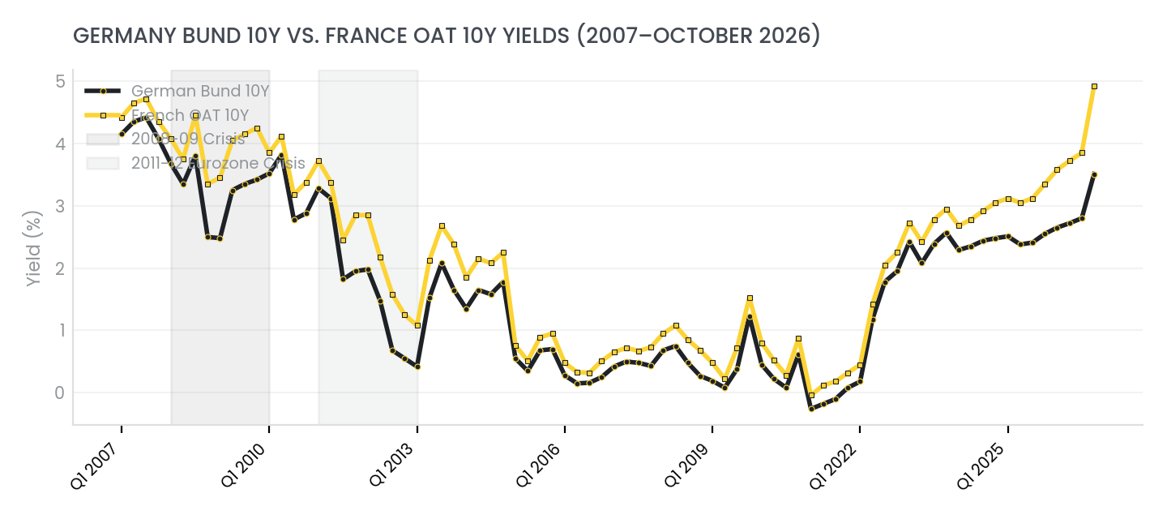
Figure 1. German Bund 10Y vs. French OAT 10Y Yields (2007 to October 2026). The spread was 27 bps pre-crisis in Q1 2007, spiked to 90 bps during the 2011-12 eurozone crisis, normalized to 21 bps in Q1 2015, and has widened to 141 bps by October 2026. The comparison to 2012 is instructive: today’s spread is wider, but confined to France alone. Source: Bloomberg, ECB, Deutsche Digital Assets.
At first glance, this looks like a problem: France’s government is being charged a massive premium to borrow relative to the eurozone’s fiscal anchor (Germany). In the orthodox reading, this signals rising concerns about French fiscal sustainability, the health of the French banking sector, or political risk around pension liabilities and tax compliance.
The Traditional Reading: Fiscal Distress
The market’s immediate interpretation of a widening Franco-German spread is straightforward: France is in trouble. Investors demand higher yields to compensate for perceived default risk or currency risk (though both economies share the euro, the ECB is the ultimate backstop only if the eurozone doesn’t fragment). France’s debt-to-GDP ratio sits above 100%. Tax collection is under pressure. Pensions are politically sensitive. Bond traders are pricing in a scenario where France’s fiscal position deteriorates faster than Germany’s.
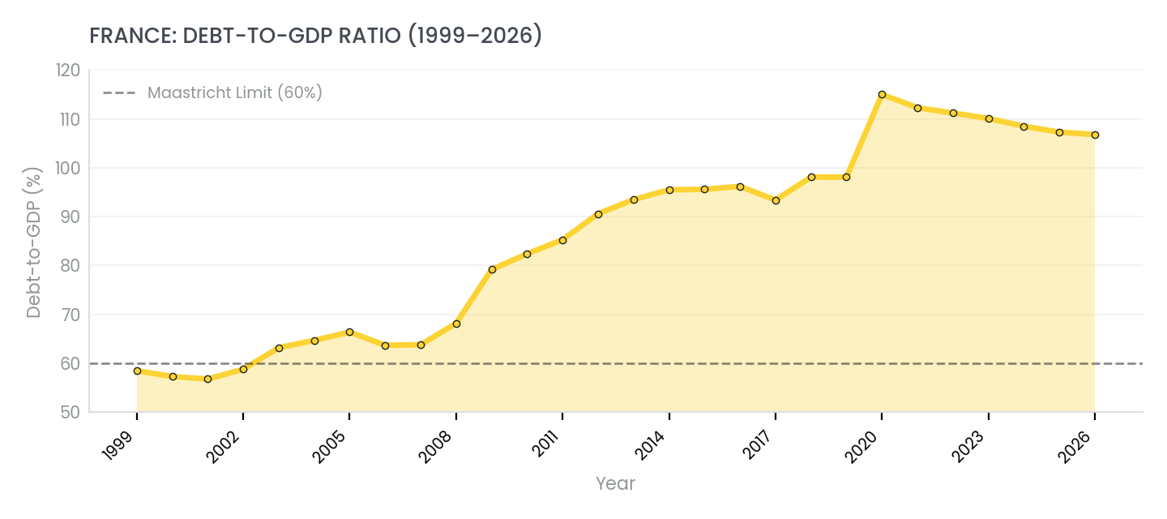
Figure 2. France: Debt-to-GDP Ratio (1999 to 2026). French debt rose from 58.5% of GDP in 1999 to 63.8% in 2007 (pre-crisis), then accelerated to 115% at the COVID peak in 2020. Current level stands at 106.8%, elevated but trending downward. The debt burden is significant, but the absence of contagion to Spain, Portugal, and Greece suggests it is not the primary driver of the current spread widening. Source: OECD, Eurostat, Deutsche Digital Assets.
This reading would normally trigger a risk-off move: investors flee European equities, rotate to U.S. Treasuries, buy defensive assets, and sell crypto. That’s the 2012 playbook. That’s the arc that spooked markets when Italian and Spanish spreads widened against Germany.
The Contrarian Reading: Tightening Overdone
But there’s a second, less obvious signal embedded in this spread: it may not be primarily about France’s fiscal fragility. It may be about the cumulative impact of two years of aggressive monetary tightening. Federal Reserve rate hikes, ECB rate hikes, and withdrawal of liquidity across both economies have created stress fractures in the financial system.
Here’s the critical evidence: the spread widening is confined to France. Spain’s 10-year yields are not blowing out against Germany. Portugal’s are not. Greece’s are not. In 2012, by contrast, the spread crisis was contagious. Spanish, Portuguese, and Greek yields spiked in tandem with Italian yields as investors questioned the very viability of the eurozone. Today, none of that is happening. The problem is France alone, not systemic eurozone fragmentation. That distinction matters. It suggests the issue is France-specific or, more likely, a mechanical consequence of uneven funding stress across the monetary union, not a crisis of confidence in the euro itself.
When central banks tighten sharply and uniformly, weaker borrowers (France, relative to Germany; peripheral eurozone, relative to core) experience immediate funding stress. Their borrowing costs spike not because of deteriorating fundamentals, but because the cost of short-term funding has exploded. Refinancing risk rises. Banks that had stable funding networks at zero or negative rates find those funding channels drying up. The spread widens as a mechanical consequence of liquidity withdrawal.
This scenario does not end with France in default. It ends with central banks pausing or reversing tightening to relieve the stress. The Fed has already signaled this: expectations of multiple rate cuts in late 2026 and 2027 are embedded in markets. The ECB, having tightened after the Fed, now faces the choice: keep rates elevated and risk eurozone fragmentation, or cut rates and support liquidity.
Why This Matters for Crypto
Bitcoin and crypto more broadly are inverse bets on tightening cycles. When central banks are adding liquidity and real rates are negative, risk assets (including crypto) rally. When central banks are draining liquidity and hiking rates, crypto sells off. The macro regime is everything.
The Franco-German spread widening is a leading indicator that tightening has overshot. Central bank policy is not determined by a single data point, but by a cascade of signals: widening spreads, funding stress, volatility in repo markets, declining credit growth, falling inflation. This spread is one of those signals. It suggests the ECB is within weeks or months of signaling an easing cycle.
If that reversal comes, the sequence typically unfolds as follows: first, gold rallies on the ‘tightening is over’ trade. Then commodities rally more broadly. Then Bitcoin follows, not because of crypto-specific news, but because the macro regime has shifted from rate-hike expectations to rate-cut expectations. Risk-on flows return. Leverage becomes cheaper. Carry trades that were underwater come back into favor.
Bitcoin closed Q3 2026 near $84,000 after a 43-44% rally during the quarter. That rally was built on Fed pause expectations. If the Franco-German spread continues to widen and the ECB pivots, the next leg up could be driven by confidence that the entire tightening cycle is ending, not just pausing, but reversing.
The Timing Question
The critical unknown is pace. Central banks move slowly, and the ECB especially is glacial in its signaling. Does the spread need to widen to 200 basis points before Lagarde cuts? Or do early signals of ECB easing come at 141 basis points? Markets are typically forward-looking enough to begin pricing in a pivot before the central bank’s press release arrives. The spread at 141 basis points today may be the market pricing in a 25–50 basis point cut from the ECB by Q1 2027.
For crypto holders, the lesson is simple: watch the Franco-German spread. If it stays between 100–150 basis points, the tightening regime is likely still intact. If it widens above 150, central banks face pressure to ease. If it contracts (spreads narrow), it signals confidence that eurozone fiscal stress is easing – which could be bullish for risk assets, but for different reasons (growth, not liquidity). The spread is a macro instrument, and Bitcoin increasingly responds to macro regimes rather than crypto-specific news.
Gold and Bitcoin are positioned to benefit if this reading proves correct. This assumes the central bank pivot is coming. The Franco-German spread is the canary in the coal mine. It is currently chirping.
REFERENCES
[1] Bloomberg (October 1, 2026) “French 10-Year Bond Yields Widen vs. German Bunds” Link: https://www.bloomberg.com
[2] ECB (September 2026) “Monetary Policy Stance and Forward Guidance” Link: https://www.ecb.europa.eu
[3] Federal Reserve (September 2026) “Dot Plot and Rate Expectations” Link: https://www.federalreserve.gov
[4] CoinGecko (October 2026) “Bitcoin Price and Macro Correlation Analysis” Link: https://www.coingecko.com
IImportant Notices:
The material and information contained in this article is for informational purposes only. Deutsche Digital Assets GmbH, its affiliates, and subsidiaries
are not soliciting any action based upon such material. This article is neither investment advice nor a recommendation or solicitation to buy any
securities. Performance is unpredictable. Past performance is hence not an indication of any future performance. You agree to do your own research
and due diligence before making any investment decision with respect to securities or investment opportunities discussed herein. Our articles and
reports include forward-looking statements, estimates, projections, and opinions. These may prove to be substantially inaccurate and are inherently
subject to significant risks and uncertainties beyond Deutsche Digital Assets’ control. We believe all information contained herein is accurate, reliable
and has been obtained from public sources. However, such information is presented “as is” without warranty of any kind.
This article represents solely a non-binding preliminary information which serves exclusively advertising purposes. It is not a prospectus in the sense
of the Regulation (EU) 2017/1129 (Prospectus Regulation) and the German Securities Prospectus Act (Wertpapierprospektgesetz – WpPG).
Risk Considerations:
The price of an investment in a DDA ETP may go up or down and the investor may not get back the amount invested. The price performance of
cryptocurrencies is highly volatile and unpredictable. Past performance is hence no guarantee of future performance. You agree to do your own
research and due diligence before making any investment decision with respect to securities or investment opportunities discussed herein. The
approval of the prospectus should not be construed as an endorsement of the securities offered or admitted to trading on a Regulated Market. These
are not extensive risk considerations. Prospective investors should read the prospectus before making any investment decision in order to fully
understand the potential risks and rewards of deciding to invest in the securities. The prospectus of each ETP product is available at DDA Crypto ETPs –
Deutsche Digital Assets.
Securities issued by DDA Europe GmbH, DDA ETP GmbH, DDA ETP AG or any other issuer have not been registered under the U.S. Securities Act of 1933,
as amended, (the “Securities Act”). The notes are being offered outside the United States of America (the “United States” or “U.S.”) in accordance with
Regulation S under the Securities Act (“Regulation S”), and may not be offered, sold or delivered within the United States except pursuant to an
exemption from, or in a transaction not subject to, the registration requirements of the Securities Act. The information provided on this website is not
directed to any United States person or legal entity or any state thereof, or any of its territories or possessions. U.S. PERSONS (AS DEFINED IN REGULATION
S) AND LEGAL ENTITIES RESIDENT IN THE UNITED STATES MAY NOT ENTER THIS WEBSITE. Information from this website may not be distributed or
redistributed into the United States or into any jurisdiction where it is not permitted.
@Deutsche Digital Assets │2026│ DDA Crypto Espresso : The Franco-German Spread Is Signaling a Central Bank Pivot. Bitcoin Is Watching.