






KEY TAKEAWAYS
- Germany’s Federal Ministry of Finance has drafted legislation that would reclassify crypto gains acquired after December 31, 2026 as capital income under §20 EStG, subject to the standard 25% flat withholding tax plus 5.5% solidarity surcharge (26.375% effective rate)—but only for crypto.
- The glaring omission: physical gold and precious metals purchased after December 31, 2026 will remain under §23 EStG, preserving their tax-free status after 365-day holding periods. A German investor can hold gold indefinitely tax-free; the same investor holding Bitcoin faces 26.375% capital gains tax, regardless of duration.
- This is not tax harmonization. It is differential treatment of functionally equivalent store-of-value assets. The bill reclassifies crypto as a security when it suits revenue purposes, but refuses to reclassify gold the same way—creating a transparent arbitrage opportunity and exposing the political logic underneath.
- The bill grandfathers all crypto acquired on or before December 31, 2026 under the old rules, creating a 106-day accumulation window. But the deeper question is why Berlin is penalizing one asset class while protecting another with the same risk-free holding characteristics.
On September 10, 2026, Germany’s Federal Ministry of Finance circulated a draft bill (Gesetzentwurf) that fundamentally restructures the tax treatment of cryptocurrency gains. The proposal, which still requires approval from both the Bundestag and Bundesrat, would end a 15-year tax advantage that has made Germany one of Europe’s most crypto-friendly jurisdictions: the ability to hold Bitcoin, Ethereum, and other digital assets completely tax-free once held for more than twelve months.
The new regime, effective for all crypto acquired after December 31, 2026, would reclassify capital gains from cryptocurrencies as Kapitaleinkünfte (capital income) under §20 of the German Income Tax Act (Einkommensteuergesetz, EStG). This move brings crypto under the standard 25% Abgeltungssteuer (flat withholding tax) plus 5.5% solidarity surcharge, for a combined effective rate of 26.375%. For comparison: that’s the same rate applied to stock dividends, bond interest, and fund distributions. The implication is unmistakable: Germany is treating crypto as a security, not a currency or alternative asset class.
The Old Rule: Why It Mattered
Under the current rules (§23 EStG), private investors in Germany can sell crypto holdings completely tax-free provided they held the asset for more than 365 days. This applies regardless of gain size—a €100,000 profit on Bitcoin held for 13 months incurs zero capital gains tax. Holdings of less than 12 months are taxable, but only gains above €600 (recently raised from the previous €600 threshold) are subject to your marginal income tax rate, which can be as high as 45% depending on total income.
That distinction—tax-free after 12 months, progressive income tax otherwise—has been the cornerstone of German crypto investment strategy for years. It created a powerful incentive to hold: buy in January, wait 13 months, sell tax-free in February. No capital gains tax. No Abgeltungssteuer. No solidarity surcharge. It is, arguably, the most generous long-term crypto tax regime in Europe and has attracted substantial institutional and retail capital to German custody providers and brokers.
The Gold Problem: Why This Isn’t Really About Harmonization
Here is where the bill’s logic breaks down: under German tax law, physical gold and precious metals also enjoy tax-free status after 12 months of holding under §23 EStG. An investor who buys 1 kilogram of gold on January 1, 2026, holds it for 13 months, and sells it on February 1, 2027, pays zero capital gains tax—no Abgeltungssteuer, no solidarity surcharge. The same treatment applies to silver, platinum, and other precious metals held as physical assets.
Yet the draft bill does not touch gold taxation. Gold will remain under §23 EStG indefinitely. Only crypto is being reclassified as a security and moved to §20 EStG. This is the critical flaw: if the government’s objective is to harmonize long-term capital gains taxation—to apply consistent treatment to assets with similar economic characteristics—then gold should also move under Abgeltungssteuer. But it isn’t.
The comparison is not incidental. Crypto and precious metals are functionally analogous: both are store-of-value assets with no cash flow (no dividends, no interest), both are liquid markets, both are held as inflation hedges or portfolio diversifiers. A rational tax code would either exempt both from capital gains taxation or tax both under the flat-rate regime. Germany’s proposal does neither. It singles out crypto for punitive treatment while leaving gold untouched.
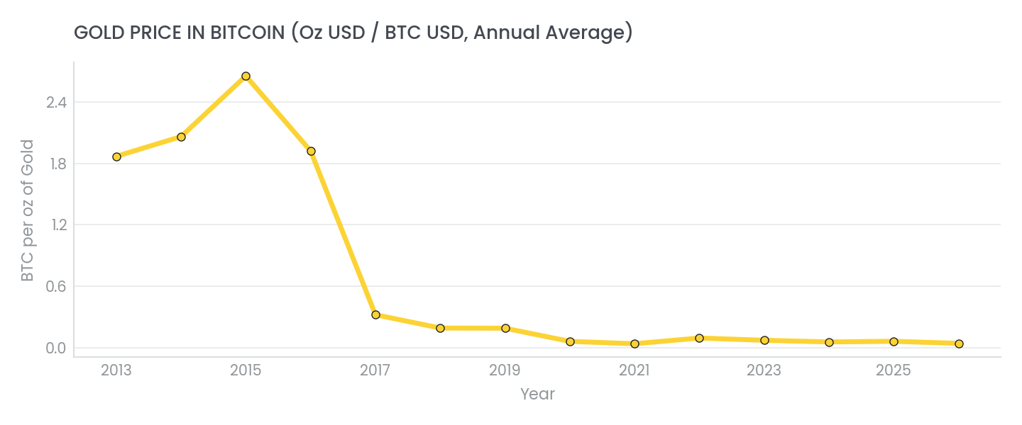
Figure 1 — Gold Price in Bitcoin (Annual Average, 2011–2026). In 2011, an ounce of gold cost 318 BTC. In 2026, it costs 0.041 BTC. The 99.97% decline illustrates Bitcoin’s appreciation relative to gold over 15 years. Source: CoinGecko, London Bullion Market Association, Deutsche Digital Assets.
The New Rule: Full Alignment with Securities Tax
Under the draft, all gains on crypto acquired after December 31, 2026 would be taxable at 26.375% regardless of holding period. Hold Bitcoin for 5 years: 26.375% on the gain. Hold it for 13 months: 26.375% on the gain. The holding period becomes irrelevant. Crypto is reclassified from a private asset under §23 EStG into a financial instrument under §20 EStG—and subjected to flat-rate withholding tax.
The draft does provide some mitigants: losses on crypto can now be offset against gains from stocks, bonds, and other securities. There is a continued Sparerpauschbetrag of €1,000 per individual per year on all capital income combined. And for taxpayers whose marginal rate falls below 25%, a Günstigerprüfung would apply the lower rate instead. But these are minor carve-outs. None of them restore parity with gold, and none of them restore the core advantage: tax-free status for long-term holdings.
What makes this especially difficult to defend: the legislation explicitly contradicts its own stated rationale of ‘harmonization.’ If Berlin wanted to harmonize long-term capital gains taxation, it would tax gold and crypto identically. It hasn’t. This suggests the motivation is not coherent tax policy design, but targeted revenue extraction from an asset class deemed politically vulnerable.
The Grandfathering Clause: The December 31, 2026 Rush
Here is the critical detail that will drive market behavior over the next 16 weeks: all crypto acquired on or before December 31, 2026 will continue to be taxed under the old rules. This means an investor who buys 1 Bitcoin on December 30, 2026, and holds it until June 2027, will owe zero tax on the gain. An investor who buys 1 Bitcoin on January 2, 2027, and holds it until June 2027, will owe 26.375% on the gain.
That cliff creates a powerful incentive to front-load purchases before year-end. It also creates a precedent: if you are a German investor, acquisitions before the cutoff are ‘grandfathered’ into the old regime in perpetuity. That incentivizes accumulation now, within the next 106 days, to lock in the tax-free treatment on future sales, no matter when those sales occur.
From a capital flows perspective, this is significant. German brokers and custodians are likely to see elevated inflows in Q4 2026 as investors race to acquire holdings before the tax regime changes. That capital does not evaporate after December 31; it sits in existing holdings, accruing gains under the old (tax-free) framework.
The Broader Implications: Tax Policy as Regulatory Tool
Germany has long been a beacon for European crypto adoption. The combination of a sophisticated financial infrastructure, strong legal framework, and a tax regime that explicitly allowed tax-free long-term holdings made it an attractive destination for crypto investment and custody. Crypto-friendly brokers like Bitwala and Bison were built on this advantage. Regional wealth in crypto (notably in Berlin and Frankfurt) was, to some degree, enabled by this tax arbitrage.
But here is the darker implication: Berlin is not harmonizing tax treatment. It is using tax policy as a targeted regulatory tool to discourage crypto holding while protecting alternative store-of-value assets (gold). This suggests that the real policy goal is not revenue or coherent tax design—it is to make crypto ownership less attractive than the alternatives.
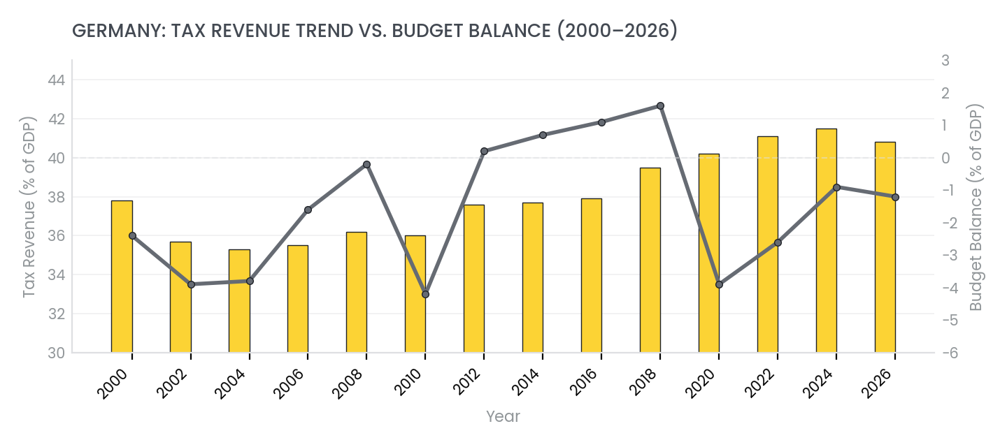
Figure 2 — Germany: Tax Revenue vs. Budget Balance (2000–2026). Tax revenue has grown from 37.8% of GDP in 2000 to 40.8% in 2026, while the budget balance remains structurally in deficit (−1.2% of GDP in 2026). The gap suggests tax policy is being used to manage persistent fiscal shortfalls, not to optimize asset classification. Source: OECD, German Federal Statistical Office (Destatis), Deutsche Digital Assets.
That is a legitimate policy choice. Governments can prefer citizens to hold traditional assets over digital ones. But it should be stated clearly. Instead, the bill frames itself as ‘harmonization’ and ‘consistency,’ when it is neither. It is selective enforcement wrapped in bureaucratic language. More problematically, the fiscal math suggests the motivation may be simpler than ideology: Germany’s tax revenue has risen from 37.8% of GDP in 2000 to 40.8% in 2026, yet the budget remains structurally in deficit. Each new tax source—crypto gains, in this case—becomes attractive not because of policy coherence, but because of revenue need.
The practical consequence: Germany’s competitive position as a crypto hub erodes sharply. Portugal’s flat 10% crypto tax (recently challenged but still broadly in effect), Malta’s generous framework, and Switzerland’s canton-based flexibility all remain more attractive. More significantly, the gap between crypto and gold taxation creates a transparent incentive for investors to shift allocation away from digital assets and back toward precious metals—exactly the opposite of what advocates for innovation would want.
The Path Forward: Timeline and Legislative Risk
The bill is still in draft form and must pass both chambers of the German parliament. The Bundestag (lower house) and Bundesrat (upper house) votes are not yet scheduled. Political risk exists—crypto-friendly factions within CDU/CSU and the Greens could push back. Tax simplicity advocates might support it. Budget hawks might argue it generates insufficient revenue. But the draft having been officially circulated by the Finance Ministry suggests serious intent.
The effective date, January 1, 2027, is less than four months away. That timeline is tight but achievable if the bill moves through parliament by November or December 2026. The question for German holders and institutions is not whether this passes, but how quickly. The sooner it passes, the more certainty around the December 31, 2026 cutoff.
For DDA and other institutions managing European crypto exposure, the implications are immediate and structural. German investors now have a hard 106-day window to accumulate holdings before the tax regime flips. Inflows into German custodians will spike in Q4 2026 as investors front-run the cutoff. But the long-term picture is a decisive shift in Germany’s policy stance toward crypto: from neutral-to-favorable (relative to other assets) to explicitly hostile (relative to gold and commodities).
This bill, if passed, will be remembered as the moment Germany chose to penalize digital assets while protecting traditional ones—not through coherent tax design, but through selective application of §20 EStG to crypto alone. The stated rationale of ‘harmonization’ cannot withstand scrutiny. The real logic is political: crypto is seen as speculative and destabilizing, while gold retains its mystique as a ‘safe’ store of value. Tax policy is being weaponized to encode that preference into law.
For crypto advocates, the takeaway is sobering: tax frameworks matter, but they are vulnerable to political shifts. For institutions allocating across asset classes, the message is clear: if you are German and bullish on long-term crypto holdings, the 106-day accumulation window before December 31, 2026 is your last chance to lock in favorable treatment. After that, the choice becomes whether to accept 26.375% taxation, shift holdings to Gold, or relocate capital to more crypto-friendly jurisdictions. Germany just tipped its hand on which it prefers.
REFERENCES
[1] German Federal Ministry of Finance (September 2026) “Draft Bill on Cryptocurrency Taxation” Link: https://www.bundesfinanzministerium.de
[2] Die Welt (September 10, 2026) “Germany Drafts New Crypto Tax Framework” Link: https://www.welt.de
[3] CoinDesk (September 9, 2026) “Germany Moves to Tax Bitcoin Like Stocks as New Draft Bill Targets Tax-Free Gains” Link: https://www.coindesk.com
[4] KuCoin (September 2026) “Germany Proposes 25% Crypto Tax on Assets Acquired After 2026” Link: https://www.kucoin.com
Wichtige Hinweise:
The material and information contained in this article is for informational purposes only. Deutsche Digital Assets GmbH, its affiliates, and subsidiaries
are not soliciting any action based upon such material. This article is neither investment advice nor a recommendation or solicitation to buy any
securities. Performance is unpredictable. Past performance is hence not an indication of any future performance. You agree to do your own research
and due diligence before making any investment decision with respect to securities or investment opportunities discussed herein. Our articles and
reports include forward-looking statements, estimates, projections, and opinions. These may prove to be substantially inaccurate and are inherently
subject to significant risks and uncertainties beyond Deutsche Digital Assets’ control. We believe all information contained herein is accurate, reliable
and has been obtained from public sources. However, such information is presented “as is” without warranty of any kind.
This article represents solely a non-binding preliminary information which serves exclusively advertising purposes. It is not a prospectus in the sense
of the Regulation (EU) 2017/1129 (Prospectus Regulation) and the German Securities Prospectus Act (Wertpapierprospektgesetz – WpPG).
Risikoerwägungen:
The price of an investment in a DDA ETP may go up or down and the investor may not get back the amount invested. The price performance of
cryptocurrencies is highly volatile and unpredictable. Past performance is hence no guarantee of future performance. You agree to do your own
research and due diligence before making any investment decision with respect to securities or investment opportunities discussed herein. The
approval of the prospectus should not be construed as an endorsement of the securities offered or admitted to trading on a Regulated Market. These
are not extensive risk considerations. Prospective investors should read the prospectus before making any investment decision in order to fully
understand the potential risks and rewards of deciding to invest in the securities. The prospectus of each ETP product is available at DDA Crypto ETPs –
Deutsche Digital Assets.
Securities issued by DDA Europe GmbH, DDA ETP GmbH, DDA ETP AG or any other issuer have not been registered under the U.S. Securities Act of 1933,
as amended, (the “Securities Act”). The notes are being offered outside the United States of America (the “United States” or “U.S.”) in accordance with
Regulation S under the Securities Act (“Regulation S”), and may not be offered, sold or delivered within the United States except pursuant to an
exemption from, or in a transaction not subject to, the registration requirements of the Securities Act. The information provided on this website is not
directed to any United States person or legal entity or any state thereof, or any of its territories or possessions. U.S. PERSONS (AS DEFINED IN REGULATION
S) AND LEGAL ENTITIES RESIDENT IN THE UNITED STATES MAY NOT ENTER THIS WEBSITE. Information from this website may not be distributed or
redistributed into the United States or into any jurisdiction where it is not permitted.
@Deutsche Digital Assets │2026│ DDA Crypto Espresso : Germany’s Crypto Tax Regime Is About to Flip. Here’s Why It Matters.